
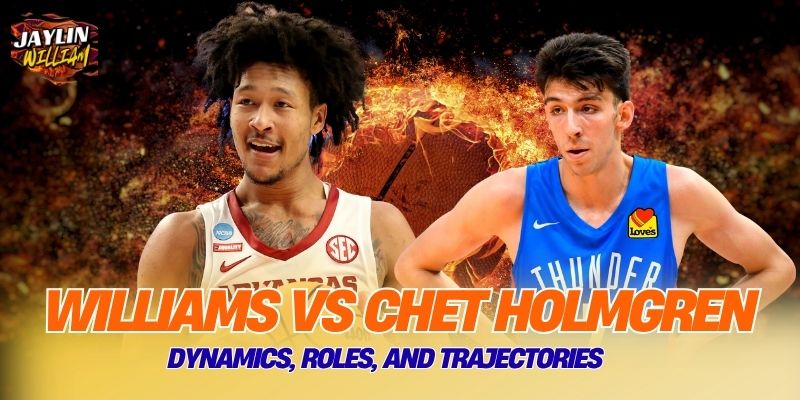
When two young front-court talents from the same roster garner attention, it raises interesting questions: How do their roles differ? Who is making the larger impact at this stage? On the Oklahoma City Thunder we have Jaylin Williams and Chet Holmgren, both drafted within the last few years, both still in developmental stages yet already contributing. This article investigates “Jaylin Williams vs Chet Holmgren” — comparing their profiles, roles, statistical footprints, and what each means for the Thunder.
Profiles and Beginnings
To start, let’s look at each player’s background and how they arrived in OKC.
Jaylin Williams — The high-motor role player
Jaylin Williams, drafted 34th overall in 2022, stands at 6 ′9″ (2.06 m) and roughly 240 lb (109 kg), coming out of the University of Arkansas. He has gradually carved out a role as a versatile forward who can rebound, defend, and provide energy off the bench. For the 2024-25 season he averaged 5.9 points, 5.6 rebounds and 2.6 assists in 16.7 minutes per game.
Chet Holmgren — The unicorn big man
Chet Holmgren entered the league as the 2nd overall pick in 2022. At 7 ′1″ (216 cm) and about 208 lb (94 kg) early on, he’s a thin but highly skilled forward/center hybrid known for shot-making, rim protection and positional versatility. In the 2023-24 season he averaged approximately 16.5 points per game and 7.9 rebounds.

Statistical Comparison
Now that we’ve sketched their profiles, let’s compare their on-court production and roles more directly.
Traditional stats side-by-side
Here is a simplified table comparing recent season averages (regular season) for both players:
| Player | Season | PPG | RPG | APG | FG% | Role |
| Jaylin Williams | 2024-25 | 5.9 | 5.6 | 2.6 | ~43.9% | Role player, bench |
| Chet Holmgren | 2024-25 | ~15.0 | ~8.0 | ~2.0 | ~49.0% | Starter, two-way |
This table shows how Holmgren carries a heavier statistical load, while Williams plays fewer minutes but contributes in multiple categories.
Role, minutes and opportunity
The difference in minutes and usage is critical. Williams’s 16.7 minutes per game in 2024-25 indicate a bench role. Holmgren’s starter minutes place more demand and expectation on his performance. The usage and role profiles are thus very different: Williams is developing into a trusted rotation piece; Holmgren is expected to be a core contributor moving forward.
Advanced impact and ceilings
Beyond raw stats, Holmgren’s positional uniqueness — a big man who shoots threes, blocks shots, and spaces the floor — gives him a higher ceiling. On the other hand, Williams brings versatility: rebounding, play-making from the forward spot, and energy plays. In a team context, Holmgren is closer to “star in development,” while Williams is a high-value role-player who can impact wins even on limited minutes.
Roles Within the Thunder Framework
How do these two players fit into the Thunder’s system, and what differentiates their impact?
Holmgren as the foundational piece
Holmgren is viewed as one of the foundational young pieces for OKC’s future. His skill set aligns with modern NBA requirements: shooting from range, switching defense, rim protection. The Thunder rely on him to anchor the front-court both offensively and defensively. Injuries have limited him at times, but when healthy, he fits the core identity.
Williams as the glue role and energy engine
Williams plays a different, yet complementary role. He may not rack up 20 points a night, but he helps stabilize lineups. His ability to rebound, pass, act defensively and do the ‘dirty work’ makes him valuable. His contract extension (three-year, $24 million) signals the Thunder’s belief in his role.
Synergy and collaboration
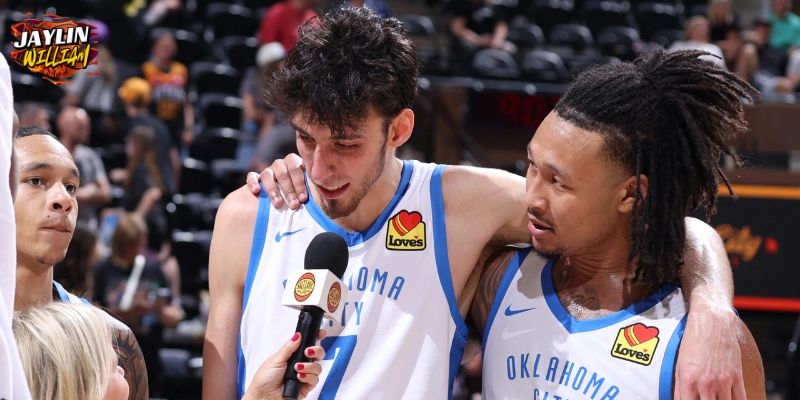
Rather than competition, the interesting dynamic is how they complement each other: Holmgren draws defensive attention, opens space, and focuses on finishing and protecting the rim. Williams provides secondary scoring, smart rotations, hustle plays and relief off the bench. In a well-built roster, having both a rising star and a well-defined role-player often creates deeper team strength.
Strengths, Weaknesses and Development Paths
Despite their accomplishments, both players have development needs. Let’s examine what they do well and where they need growth.
Holmgren’s strengths & areas to refine
Strengths: Floor spacing, shot creation, shot blocking, positional flexibility.
Weaknesses/Challenges: Durability (still young and coming off injury), physical strength for the rigours of the NBA, consistency in defensive matchups. As he continues to build his body and game, his ceiling remains high.
Williams’s strengths & areas to refine
Strengths: Rebounding, energy, multi-faceted contributions (rebounds + assists + steals/blocks), high basketball IQ in his role.
Weaknesses/Challenges: Needs more consistency offensively, greater shooting volume and efficiency, increased minutes and decision-making under pressure. His pathway is realistic, but incremental rather than explosive.
Paths for growth
- For Holmgren: Expand strength, stay healthy, evolve into an every-night two-way star.
- For Williams: Maximise minutes, continue to refine shooting and play-making, become a trusted second/third unit anchor.
To compare their evolving metrics over multiple seasons — from efficiency ratings to win shares — visit the Stats & Highlights page for comprehensive insights into each player’s statistical growth.

What This Means for the Thunder’s Future
The broader implication of “Jaylin Williams vs Chet Holmgren” lies in the Thunder’s trajectory.
Positioning for sustainability
With Holmgren as a potential long-term star and Williams as a dependable role piece, OKC is set up for sustained competitiveness. Holmgren’s ceiling provides star power; Williams’s reliability helps maintain depth. This gives the Thunder flexibility, balance and future stability.
Building a balanced roster around them
Star-teams often fail because of weak depth. Williams exemplifies the kind of high-value mid-tier contract player who supports stars without dominating salary cap. Holmgren, meanwhile, will command maximum type value. Having both is a win for roster construction.
Narrative of complementary pieces rather than head-to-head
“Vs” in the headline captures comparison, but within the Thunder ecosystem the story is more about synergy than rivalry. Holmgren’s rise plus Williams’s steady growth combine toward a common goal: contention. If both continue upward, OKC’s window looks wide open.

Conclusion
In comparing Jaylin Williams and Chet Holmgren, the takeaway is clear: these are two different profiles locked in on a shared vision. Holmgren brings star potential, positional uniqueness and starter-level impact. Williams supplies work ethic, versatility and role-excellence in his rotation slot. For the Thunder, both matter — one as the future cornerstone, the other as the reliable piece that enables it. Watching them evolve side by side affords fans the best of both worlds: a rising star journey and a role-player’s quiet but effective climb. As the seasons unfold, the “vs” becomes less about competition and more about complementary pieces propelling a young, talented franchise.
